
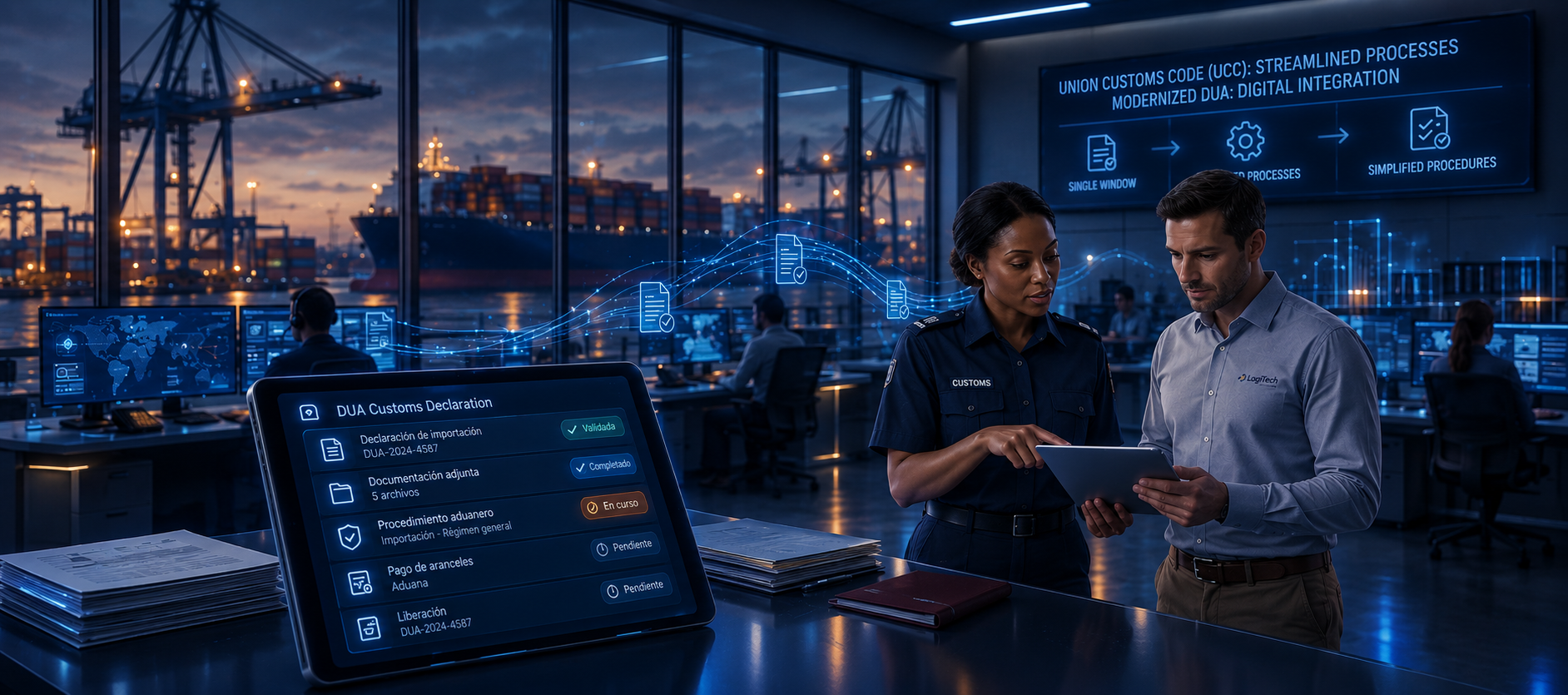
The DUA is the declaration through which goods are presented to customs for import, export or transit. This guide explains what it is, who lodges it, where its data comes from, the most common errors and what has changed with the Union Customs Code.
Any goods entering the European Union, leaving it or crossing it in transit must be declared to customs. For decades, in Spain that declaration has had a name everyone in the industry knows: the DUA (Documento Único Administrativo), the Single Administrative Document.
The DUA sits at the center of the work of any customs broker, freight forwarder or importer, and also at the center of many of their problems: it's the last link in a chain of documents and the place where a transcription error turns into a delay, an inspection or an amendment. On top of that, its format has changed in recent years with the application of the Union Customs Code. This guide covers what the DUA is, how it's prepared and what has changed.
The DUA is the customs declaration through which the declarant tells customs which goods it wants to place under a customs procedure, such as import, export or transit, and under what conditions. It's called “single” because it was created to replace the various national forms with a common model across EU countries.
The declaration includes, among other things, the importer or exporter, the representative if there is one, the description of the goods and their TARIC commodity code, the country of origin, the customs value, the weight, the packages, the means of transport and the requested procedure. With that information customs calculates duties and import VAT, applies the relevant controls and grants release, that is, permission for the goods to continue on their way.
Today the declaration is lodged electronically, and the term “DUA” is still used day to day even though the data model has changed, as explained below.
The DUA serves several purposes at once, which explains why its data has to be so accurate.
The first is tax: it is the basis for settling customs duties and import VAT, and it remains as proof of the transaction for the tax authorities. The second is control: it allows customs to apply security, health or trade controls and decide whether a consignment goes through the green channel or needs a documentary or physical check. The third is statistical: declaration data feeds official foreign trade figures. And for the operator, the DUA is also a traceability document: it proves that goods left or entered legally, which an exporter needs, for example, to justify the VAT exemption on a sale outside the EU.
Although people talk about the DUA as if it were one thing, the declaration changes depending on the procedure the goods are placed under. Three are the most common in daily operations.
The import DUA is lodged to release goods arriving from outside the EU for free circulation. It's the one that triggers the settlement of duties and VAT and the most demanding in terms of data. The export DUA accompanies goods leaving for a third country and allows the exporter to prove that exit. The transit declaration, such as the T1, lets goods move under customs supervision between two points without paying duties yet, for example from the port of arrival to an inland customs office.
There are also declarations for special procedures, such as customs warehousing or inward processing, which follow the same logic with specific data.
Responsibility for the declaration lies with the declarant, usually the importer or exporter. It can lodge it itself or, as happens in the vast majority of cases, through a customs representative: a customs broker or a freight forwarder with its own customs department.
The representative can act under direct representation, in the name and on behalf of the customer, or indirect representation, in its own name but on behalf of the customer. The difference matters because under indirect representation the representative shares liability for the customs debt. That's why customs departments check so carefully the data they receive: an error that isn't theirs can end up being theirs.
The DUA isn't written from scratch. Almost all its information already exists in other documents in the shipment file, and preparing the declaration is largely about gathering it and checking that it matches. The usual sources are these:
The problem is that these documents arrive in different formats, from different suppliers and almost always as PDFs. And the same data the operations team already typed into the TMS when opening the shipment file gets retyped into the clearance software to prepare the declaration. That double entry is the source of many of the errors seen at customs.
Most incidents with a declaration don't come from misreading the rules, but from data that doesn't match between documents. The most common cases are:
Each of these errors has a cost: amendments, delays in release, storage charges while it's resolved, inspections and, in the most serious cases, penalties. And almost all of them are avoided the same way: by taking the data from the original document only once and validating it before it reaches the declaration.
Regulation (EU) No 952/2013 laying down the Union Customs Code (UCC) sets the common framework for European customs and requires exchanges with customs to be electronic and to follow a harmonized data model. Applying it has required each country to overhaul its systems, and in Spain that change has come in phases.
For exports, the Spanish Tax Agency launched the AES P1 system, adapted to the UCC, which has been the only system accepted for export declarations since 9 May 2023. For imports, after a coexistence period, the Tax Agency announced the definitive closure of the pre-UCC import declaration on 14 October 2025. Since then, only the new declaration is accepted.
In practice, the industry still talks about the “DUA”, but what gets lodged is no longer the familiar box-based form. It's a declaration with data structured in levels (the declaration header and each of its items), designed to be exchanged between systems. For customs teams this has a clear consequence: the quality of the input data matters more than ever, because the declaration is built and validated automatically.
A freight forwarder in Barcelona handles the import of a container of electronic components arriving from Asia. The shipping line sends the BL, the supplier sends the commercial invoice and packing list, and the customer forwards the certificate of origin. Everything arrives by email, as PDFs.
In a manual process, the customs specialist opens each document and types into the clearance software the importer, the description, the value and currency, the incoterm, the weights, the packages, the container number and the origin. They look up the commodity code in the product record, check that the packing list weights match the BL and that the value matches the invoice. If the container holds twenty different references, that's twenty items to check one by one. A declaration like this can easily take half an hour, and the same specialist prepares many a day.
With an automated workflow, documents are read as soon as they arrive. The extraction engine identifies the invoice, the packing list and the BL, extracts their data, checks that weights, packages and values match across them and loads them into the clearance software with the proposed classification for each item. The specialist no longer types: they review the pre-filled declaration and focus only on what the system flags as doubtful, such as an item with no previous classification or a weight that doesn't match.
80% less manual time in document processes automated with Kaiona.
Automating declarations doesn't require replacing the customs software, which is usually certified and well established in the team. What changes is how data reaches it. An approach that works rests on four steps.
First, capture documents where they already arrive, usually the email inbox, without asking suppliers or customers to change anything. Second, extract the data with AI trained on logistics documents, able to read invoices, BLs, AWBs and certificates in any format; that's what K-Scan does. Third, validate data across documents before it reaches the declaration, within the digital shipment file managed by K-Flow. And fourth, integrate with the clearance software and the TMS, so the declaration is pre-filled without copy and paste, which is the role of K-Plug.
The result is the same as in other document processes: the team moves from transcribing to reviewing by exception. It's the same logic we explain in our guide to document management in logistics, applied to the point where an error costs the most.
The DUA remains the centerpiece of customs clearance, even though its format has evolved with the Union Customs Code. What hasn't changed is that it depends on data that, in many teams, is written several times before reaching customs.
If your customs department spends much of the day typing data that's already in invoices, BLs and packing lists, Kaiona can help you measure how much time goes into it and how much can be automated without changing your clearance software.
DUA stands for Documento Único Administrativo (Single Administrative Document), the customs declaration through which goods are placed under a customs procedure such as import, export or transit.
The importer or exporter, as declarant. In practice, most do it through a customs representative, usually a customs broker or a freight forwarder with a customs department.
The term is still used, but the format has changed with the Union Customs Code. In Spain, exports have been declared through the AES system since May 2023, and imports through the new UCC declaration since 14 October 2025.
It's the declaration lodged to release goods from outside the EU for free circulation. Customs duties and import VAT are settled on the basis of it.
No, Kaiona is not a traditional SaaS. We don't sell you a generic platform that you have to adapt to, nor a monthly user license for your team to do the work.
Kaiona functions as a custom artificial intelligence and automation layer that connects directly with your current systems (ERPs, CRMs, document management). We handle the technical complexity so that you only see the results within your usual workflow.