

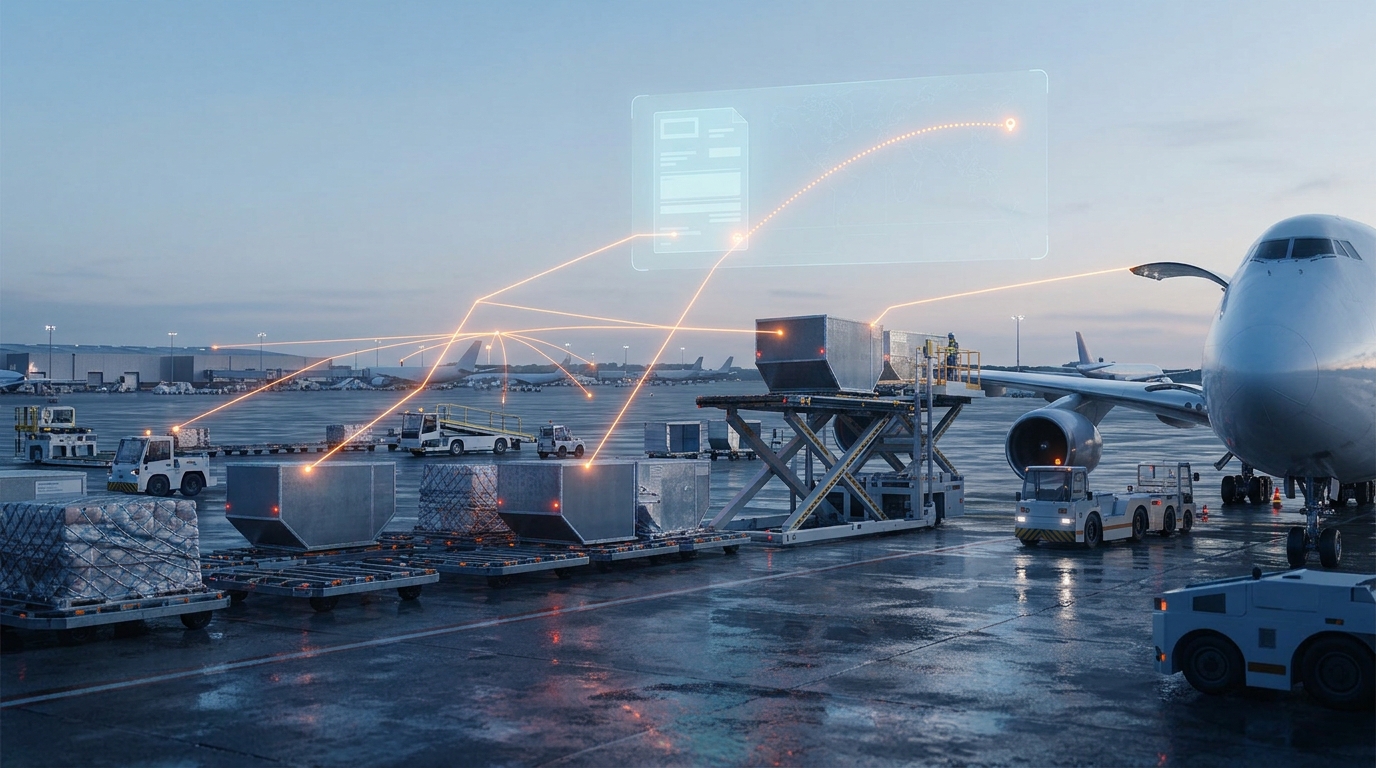
The AWB is the contract of carriage for every air cargo shipment. We explain its functions, how the MAWB and HAWB differ and which data is worth checking.
Every air cargo shipment is tied to an eleven-digit number that everyone involved repeats throughout the journey: the AWB number. It is used to book space, identify the cargo at the airport, submit information to customs and invoice the charges. If that document contains an error, the error travels with the goods all the way to destination.
This guide explains what an air waybill is, what it is used for, how the MAWB and the HAWB differ, what data it contains and what has changed with the electronic air waybill. If you are trying to track a shipment, the AWB number goes into the airline’s tracking page; here we focus on the document itself and how it is managed.
The AWB (air waybill) is the document that evidences the contract for the carriage of goods by air between the shipper and the airline. It is the air equivalent of the ocean bill of lading and of the CMR for road transport, with one important difference: it is not a document of title and cannot be negotiated or endorsed.
Its legal basis is the 1999 Montreal Convention, which governs international carriage by air. Its article 4 states that an air waybill shall be delivered for the carriage of cargo, but allows it to be replaced by any other means that preserves a record of the carriage, which opened the door to the electronic version. The conditions of contract and the format of the document follow the resolutions of IATA, the airlines’ association.
The AWB does several jobs at once, and all of them depend on its data being correct:
Under the Montreal Convention, the air waybill is prima facie evidence of the conclusion of the contract and of the acceptance of the cargo under the conditions it states. That is why a wrongly entered weight or package count is not a minor detail: it is what will be taken as true if there is a claim.
In consolidated air cargo, two levels of air waybill coexist. The MAWB (master air waybill) is issued by the airline, or by the forwarder on its behalf, and covers the whole consolidated shipment between the forwarder at origin and its agent at destination. The HAWB (house air waybill) is issued by the forwarder to each of its customers and covers each shipper’s specific consignment within that consolidation.
A single flight can carry one MAWB with twenty HAWBs under it. For the airline there is one shipment; for the forwarder and for customs there are twenty shippers, twenty consignees and twenty different goods that must add up to the master total. That double layer is one of the reasons the AWB generates so much administrative work at a freight forwarder.
The standard IATA format includes, among others, the following data:
Several of these fields come from other documents: pieces and weights from the packing list, the description from the commercial invoice. When they don’t match, the discrepancy shows up later at the security check, at customs or on the freight invoice.
For years now, the paper AWB has coexisted with its electronic version. The e-AWB replaces the face of the document with electronic messages between the forwarder and the airline, and the reverse, with the conditions of contract, with an agreement. To avoid signing a separate agreement with every airline, IATA created the Multilateral e-AWB Agreement (Resolution 672): the forwarder signs it once and each airline activates it at each location.
The e-AWB removes paper from the contract of carriage, but on its own it doesn’t solve the rest of the shipment file. The commercial invoice, the packing list, the certificates and the supplier invoices still arrive in different formats, and someone has to extract their data and check it against the air waybill.
A freight forwarder in Madrid prepares a weekly air consolidation to Mexico City with goods from about fifteen exporters. For each one it issues a HAWB based on the invoice and packing list the customer sends, and then a MAWB with the total for the airline.
In a manual process, the export team types the data from each packing list into its system, adds up pieces and weights, issues the HAWBs and checks that the total matches the weight measured by the handling agent at the airport. When a customer updates its packing list at the last minute and the change doesn’t reach the system, the MAWB goes out with a weight that doesn’t add up, the airline invoices the measured weight and the difference shows up weeks later when the freight invoice is reconciled.
With the documents read automatically, each new packing list updates the shipment file as it arrives, the HAWBs are generated from validated data and the master total is recalculated on its own. Weight differences are caught before the flight, not on the invoice.
80% less manual time in document processes automated with Kaiona.
A reliable AWB depends on the data that feeds it arriving correctly. Kaiona reads air waybills, invoices, packing lists and certificates in any format (K-Scan), groups them by shipment file and cross-checks their data (K-Flow), and sends it to the TMS or ERP without retyping (K-Plug). The same approach applies to document management in logistics as a whole.
If you work at a freight forwarder, we explain how we apply it on our freight forwarding software page. And to understand the forwarder’s role across the whole shipment, read our guide what is a freight forwarder.
It stands for air waybill. It is the document that evidences the contract for the carriage of goods by air between the shipper and the airline.
It is the eleven-digit number that identifies each air waybill. The first three digits identify the airline and the rest the specific shipment. It is also used to track the shipment on the airline's website.
The MAWB is the master air waybill covering a whole consolidated shipment with the airline. The HAWB is the house air waybill the forwarder issues to each customer for its part of that consolidation.
No. Unlike the ocean bill of lading, the AWB is not negotiable or endorsable: it evidences the contract and the receipt of the cargo, but holding it does not give the right to dispose of the goods.
No, Kaiona is not a traditional SaaS. We don't sell you a generic platform that you have to adapt to, nor a monthly user license for your team to do the work.
Kaiona functions as a custom artificial intelligence and automation layer that connects directly with your current systems (ERPs, CRMs, document management). We handle the technical complexity so that you only see the results within your usual workflow.