

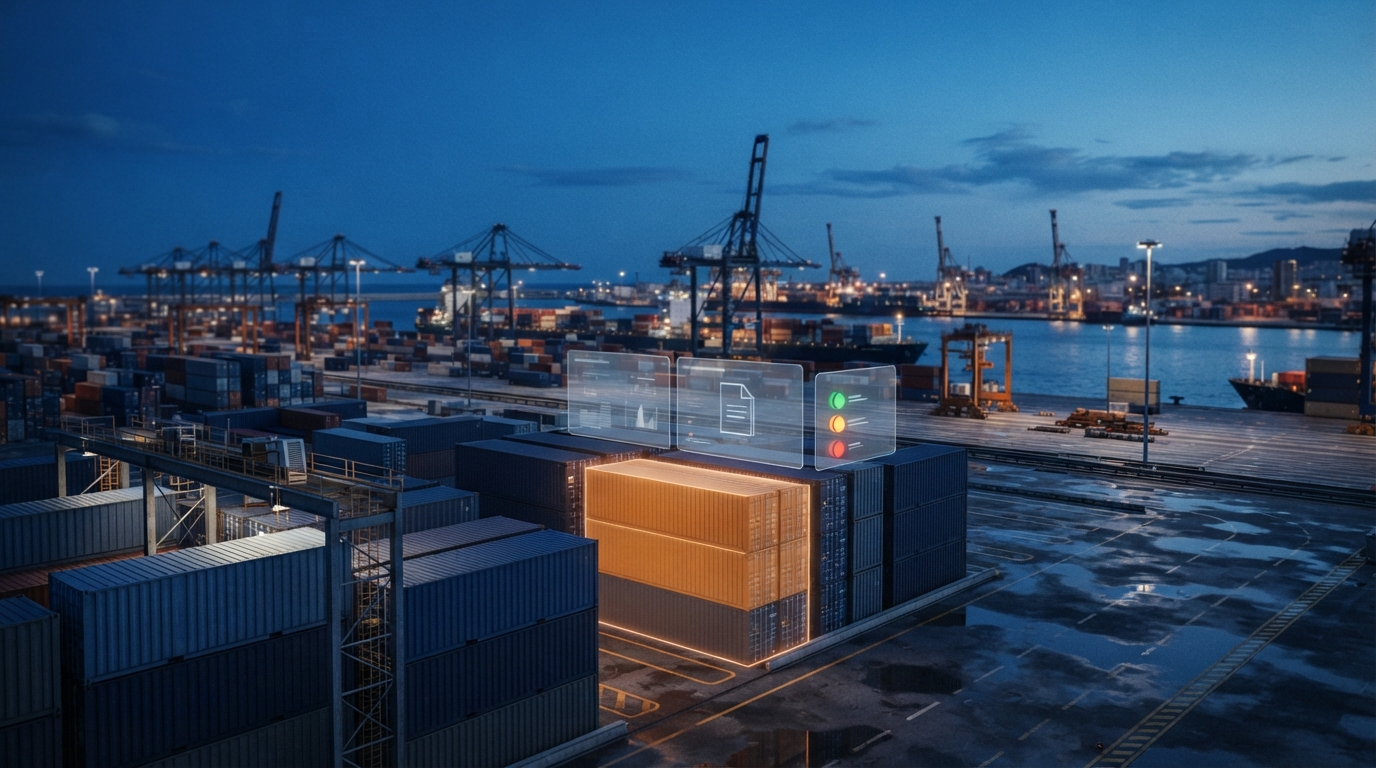
Customs clearance decides when you can actually use your goods. We explain the stages, who can handle it for you and which data errors hold it up.
A container can sit at the port for days even when it arrived on time. The ship is rarely to blame: what is missing is customs clearance, the procedure that turns foreign goods into goods the importer can actually work with. If the data is complete and consistent, it takes minutes. If not, the calls, the requests for information and the storage costs begin.
This guide is written for whoever buys the service: importers, exporters and freight forwarders. It explains what customs clearance is, how it works step by step, who can handle it on your behalf and which errors delay it most often.
Customs clearance is the set of formalities through which goods are declared to customs to place them under a customs procedure: release for free circulation to import them, export so that they leave the EU, or transit so that they move with duties suspended, as with the T1 document. It ends with the release, customs’ authorization for the declarant to dispose of the goods.
The core of the process is the customs declaration, in Spain the DUA. It records the importer or exporter, the description and tariff code of the goods, their origin, their value and the procedure requested. With that data, customs calculates duties and import VAT and decides which controls to apply.
It is worth separating this from a use of the term that fills search results: parcels bought by individuals and held by the postal service or a courier. The underlying procedure is the same, but this guide focuses on commercial operations between companies.
In a typical sea or air import, clearance follows this sequence:
Stages 1, 2, 4 and 5 depend mainly on other parties’ systems and deadlines. Stage 3 is the one the importer and its representative control, and it is where most of the time is won or lost.
When the DUA is lodged, the Spanish Tax Agency’s risk analysis system assigns it a channel that sets the level of control:
You cannot choose the channel, but you can influence what happens next. An orange-channel file is resolved quickly if the documents are at hand and their data matches the DUA. If someone has to dig them out of an inbox, or the invoice says one thing and the packing list another, release is delayed and the container keeps running up charges.
Importers and exporters can lodge the declaration themselves, but in practice most companies work through a customs representative. The rules distinguish two forms of representation.
In direct representation, the representative lodges the declaration in the name and on behalf of the client, who remains liable for the customs debt. In indirect representation, the representative lodges it in its own name but on behalf of the client, and the Spanish Tax Agency treats it as co-debtor and jointly liable. To act as a representative you must be listed in the Register of Customs Representatives and prove your qualifications, through aptitude tests in the case of individuals.
The client’s authorization to the representative is the customs clearance authorization. It can be granted per operation or globally, and it is registered with the Tax Agency. Without it, the representative cannot lodge declarations on the company’s behalf.
A customs broker is the professional or firm that specializes in customs representation: it classifies the goods, prepares the DUA and is technically responsible for it. Many freight forwarders have their own customs department and offer clearance together with transport, which cuts out an intermediary. Others subcontract that part to an external broker.
For the importer, the practical difference lies in who holds the documents. If the forwarder organizes the transport and clears the goods, the data stays within one company. If they are two different companies, each document changes hands at least once more, with the delay and retyping risk that comes with it.
The exact list depends on the goods, the origin and the procedure, but almost every import clearance starts from these documents:
Clearance is not just about having them, but about them saying the same thing. The packages and weight on the packing list must match the transport document, and the value and description on the invoice must be able to support the tariff code and the tax base in the DUA.
A green-channel clearance with complete documents is usually done the same day. What stretches the timeline is rarely customs itself, but what happens before the DUA is lodged: documents that don’t arrive, data that has to be confirmed with the supplier, or discrepancies between papers.
On costs, the importer pays the taxes on one side (duties, import VAT and, where applicable, excise duties) and the representative’s fees on the other, usually charged per declaration and per additional line. On top of that come less visible costs: temporary storage, container demurrage or inspections. These are exactly the ones that spike when the file is not ready.
Most clearance incidents come from a handful of recurring mistakes:
They all have something in common: they are data errors, not gaps in customs knowledge. They happen when information is copied from one document to another, often in a hurry and from PDFs that arrive by email.
An importer in Barcelona brings in two containers of household appliances from Shenzhen and works with a forwarder that also handles clearance. When the ship is a week away, the supplier emails the commercial invoice and the packing list, the shipping line sends the BL, and the client forwards the certificate of origin to claim a preferential duty rate.
In a manual process, the customs specialist opens each PDF and types the description, value, packages, weights and origin into the clearance software. The packing list states 1,240 packages and the BL 1,204: a typo by the supplier that nobody spots until the DUA lands in the orange channel. A corrected BL has to be requested, the container spends three more days at the terminal and the client pays storage it hadn’t budgeted for.
With the documents read automatically, the data from the invoice, the packing list and the BL is extracted as soon as it arrives and cross-checked. The package discrepancy shows up as an alert the same day, a week before arrival, and is fixed with the supplier at no cost. The specialist reviews a pre-filled declaration instead of building it from scratch.
80% less manual time in document processes automated with Kaiona.
Clearance will still depend on a professional’s judgment: the tariff classification, the most suitable procedure or the response to a request from customs. What can be automated is all the data work that comes before. Kaiona reads invoices, packing lists, transport documents and certificates in any format (K-Scan), groups them by shipment file with cross-checks (K-Flow) and connects the TMS or ERP with the clearance software so that each piece of data is entered only once (K-Plug).
If you are a customs broker, we explain how we apply it on our customs software page. If you import or export, see our page for importers and exporters. And for the rest of the process, read our guide to import and export.
It is the set of formalities for declaring goods to customs and placing them under a customs procedure, such as release for free circulation, export or transit. It ends with release, the authorization to dispose of the goods.
The importer or exporter itself, or a customs representative listed in the Spanish Tax Agency's Register of Customs Representatives. Many freight forwarders have a customs department and also act as representatives.
In direct representation, the representative declares in the name and on behalf of the client. In indirect representation, it declares in its own name but on behalf of the client, and is jointly liable for the customs debt.
It means customs will check the documents supporting the declaration before granting release. In the red channel, the goods are also physically inspected.
No, Kaiona is not a traditional SaaS. We don't sell you a generic platform that you have to adapt to, nor a monthly user license for your team to do the work.
Kaiona functions as a custom artificial intelligence and automation layer that connects directly with your current systems (ERPs, CRMs, document management). We handle the technical complexity so that you only see the results within your usual workflow.